Millions of years old: shark teeth from the primeval sea
The very oldest history of Cadzand can literally be found on the beach, in the form of fossil shark teeth.
- Warm primeval sea: millions of years ago this area lay beneath a warm sea full of sharks, rays, whales and dolphins, whose remains fossilised on the seabed.
- Sand from the Westerschelde: when the beach is raised, sand from the Westerschelde is pumped ashore, bringing the fossils back to the surface.
- Go and look: especially on a falling tide and after a good storm, there is a fair chance of spotting a shiny black tooth among the shells; our page about shark teeth explains where and how to search.
First inhabitants and the abbeys of Ghent
From the early 8th century onwards, the archives contain the first signs of people settling on the Flemish coastal plain.
- Marshy grazing land: the land consisted of creeks, salt marshes and salty meadows that were mainly used for grazing.
- Donations to Ghent: the Liber traditionum, dating from 941, records donations of coastal land to St Peter's Abbey in Ghent.
- Monks as dyke builders: the Ghent abbeys of St Peter and St Bavo would play a major role in diking and governing the area for centuries.

Cadesant: the island of quays and sand
The name Cadzand first appears as Cadesant in a charter dating from between 1111 and 1115.
- Earliest mention: in it, Count Baldwin VII of Flanders admits that he had appropriated the tithes (church taxes) of Wulpen and Cadesant, which belonged to the church of Rodenburg, today's Aardenburg.
- Meaning of the name: Cadesant refers to quays (small dykes) on sandy ground; the island kept growing as its inhabitants enclosed one stretch of salt marsh after another to create polders.
- Pioneers of dyke building: the dykes on the little island of Cadzand are among the oldest in Western Europe.
- First polders on record: in 1177 the knight Walter van Axel gave up his fief on Cadzand in favour of St Bavo's Abbey, and the charter already names polders such as Kerkepolre, Strine and Sumpel.
- Growing monastic estates: a few years later Count Philip of Alsace gave the abbey another 100 gemeten (one gemet is roughly 0.4 hectares), including land in the Sudpolre along the Dondelinsvliet.
- Neighbouring island of Zuidzande: the nearby island of Zuidzande came into being in the same way: an old church surrounded by a growing number of small polders.

Life on an island without a bridge
The heart of island life was the Mariakerk (St Mary's Church) in Cadzand-Dorp, probably founded in the 13th century by St Bavo's Abbey in Ghent.
- Gothic village church: the south aisle, the oldest part, was built between 1250 and 1300 in early Scheldt Gothic style, and the north aisle was added in the early 14th century.
- A stranded priest: in 1231 Cadzand asked the abbot of St Bavo to appoint a chaplain alongside the parish priest, because the priest was sometimes unable to sail back for days on end due to storms or rough water.
- Ferry services: the islands had regular ferry links with the mainland and with each other; on Cadzand the Sint-Marieveer, named after the patron saint of the church, was in service, and names such as Veerhoek and Veerhoeve still recall old crossing points.
- Neighbouring island of Wulpen: at the end of the 13th century the neighbouring island of Wulpen had no fewer than four parishes, a sign of how densely populated these islands were.
The battle for access to the Zwin
Because Cadzand lay at the mouth of the Zwin, the channel leading to the wealthy trading towns of Bruges and Sluis, the island was of great strategic importance for centuries.
- Battle of Cadzand (1337): in November 1337 an English fleet attacked the island, one of the first engagements of the Hundred Years' War between England and France.
- Silting up of the Zwin: from the late Middle Ages the Zwin slowly silted up, causing Bruges to lose its direct connection to the sea.
- Prince Maurice lands (1604): on 24 April 1604 Prince Maurice of Orange crossed over between Wulpen and Cadzand with a Dutch and English army; within two days the forts on the island surrendered, after which he besieged Sluis and captured it in August.
- Secret treaty (1670): in the secret Treaty of Dover, France promised Cadzand and Walcheren to England as a reward for its support in the war against the Dutch Republic, but the attack was repelled and the treaty was never carried out.

From island to mainland
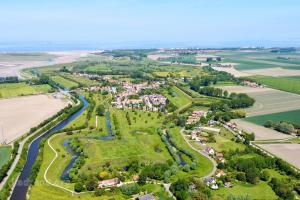
While the sea swallowed the island of Wulpen almost entirely in the 16th century, Cadzand gradually became joined to the surrounding land.
- A vanished neighbour: nothing remained of the once flourishing Wulpen and its four parishes after successive storm floods.
- Joined to the mainland: through new land reclamation Cadzand was first linked to Groede and Zuidzande and in the 18th century also to Oostburg, after which it was no longer an island.
- Creeks as scars: the winding creeks and small dykes you see on a bike ride through the polders are remnants of old channels and dyke breaches.

Huguenots and emigrants
In the 17th and 19th centuries Cadzand was both a place of refuge and a point of departure.
- French refugees (1685): Protestant Huguenots from the area around Calais settled on Cadzand from 1685, and families such as Morel and Van Houte helped rebuild a church.
- Great emigration (1847): in 1847 many people from Cadzand left for the United States in search of a better life, among others aboard the sailing ship Maria.
From farming village to seaside resort
It was not until the second half of the 19th century that the first beach guests discovered the wide beach of Cadzand.
- The Badhuis (1866): farmer Guust Albregts from Breskens sold his farm and opened an inn with guest rooms in the dunes, and around the same time a bathing machine appeared, hired from Knokke.
- First hotels (1923): Piet Faas built the Badhotel and the hotel-café De Wielingen, putting Cadzand-Bad firmly on the map as a resort.
- Boom in the 1930s: in the first half of the 1930s five more large hotels went up, along with summer cottages, villas and waffle stalls in the dunes; sea bathing gave way to a relaxing day at the beach.
- Mass tourism: after the war, growing prosperity, more leisure time and the car turned Cadzand-Bad into one of the major seaside resorts of Zeeland in the 1950s.
The Second World War and the liberation
During the German occupation the coast of Cadzand became part of the Atlantic Wall, with heavy bunkers in the dunes.
- Mobilisation and occupation: in 1939 Dutch soldiers were billeted in the Badhuis, which the German occupiers requisitioned and demolished in 1941.
- Stützpunkt Cadzand-Badhuis: on that site a heavy defensive complex with bomb-proof bunkers was built to guard the approach to the Westerschelde.
- Operation Switchback: in the autumn of 1944 Canadian troops liberated the south bank of the Westerschelde, and from 30 October to 2 November there was fierce fighting for the stronghold near Cadzand.
- Last German stronghold: on 2 November 1944 the Stützpunkt surrendered unconditionally, the last German defensive position in western Zeeuws-Vlaanderen.

Cadzand today: a renewed seaside resort
In recent decades not only the administration of Cadzand has changed, but also the face of the resort itself.
- Municipal reorganisation: on 1 April 1970 the independent municipality of Cadzand was merged into Oostburg, and since January 2003 the village has been part of the municipality of Sluis.
- Small village, lively summer: Cadzand has around 750 inhabitants, but in high season it is a lot livelier thanks to the many holidaymakers.
- Dunes to explore: the widened dunes now have walking and cycling paths with sheltered seating and views of the ships heading for Vlissingen and Antwerp.